 Songplanner
What do p, mp, mf, f, crescendo and the other vocal markings mean?
Updated 28 November 2026
Vocal markings are short instructions for how to sing the words. The letters p, mp, mf and f set a level, from soft to loud. Crescendo and decrescendo, often drawn as an opening and a closing wedge, mean growing louder and growing softer. A comma or tick above the music is a breath. Marks on a single word, such as stress, hold or cut-off, shape just that word.
None of them are absolute. Your f in a quiet ballad is not the same as f in a rock song, and that is how it is meant to work. On a lyric with no notes, you can write the same marks straight onto the words: breaths in the gap after a word, loudness under it, and anything about the voice above it.
Dynamics: how loud
- p (piano): soft.
- mp (mezzo piano): moderately soft. Mezzo means half, or moderately.
- mf (mezzo forte): moderately loud.
- f (forte): loud.
- pp and ff: very soft and very loud. You will meet them in classical songs more than in pop or musical theatre.
The Wikipedia article on dynamics says it plainly: dynamic markings are always relative, and p never means a precise level of loudness. For a singer, that makes each mark a level within this song, measured against the other marks in it.
A useful test: sing one phrase four times in a row, at p, mp, mf and f. If two of them sound the same, they will sound the same in performance too. Find four levels you can tell apart and repeat on demand, and the marks become something you can actually deliver.
Changes: getting louder or softer
- Crescendo (cresc., or a wedge that opens to the right): grow gradually louder.
- Decrescendo or diminuendo (decresc., dim., or a wedge that closes): grow gradually softer. Wikipedia notes they mean roughly the same thing.
- Subito (sub.): suddenly. Sub. p means drop to soft at once, with no fade.
- fp (fortepiano): loud, then immediately soft.
Two habits make these work. Start a crescendo soft enough that it has somewhere to go, and decide in advance where it peaks. And mark where a change ends as well as where it starts, or you will drift.
Breaths and pauses
- Breath mark (a comma or tick above the line): breathe here. The time usually comes out of the note before it, so the beat does not stop.
- Quick breath, no breath, lift: less standard in print, but common in singers' own pencil marks. A quick breath is a short sip of air; no breath means carry the phrase over; a lift is a tiny silence without air.
- Caesura (two slashes): a short break in the sound, a little longer than a breath mark but shorter than a fermata.
- Fermata (an arc with a dot, the "bird's eye"): hold the note longer than written. How much longer is up to the performer or the conductor, so agree it with your pianist.
The guide on how to mark breaths in a song covers where to put them.
Word marks: shaping one word
- Stress (accent, a small > over the note): lean into the start of the word, then ease off. Wikipedia describes the accent as an emphasized beginning that tapers off quickly.
- Hold (tenuto, a short line over the note): give the word its full length, or a little more. Tenuto asks for a note held for its full value.
- Cut-off: end the word cleanly at a chosen moment, often on a beat. It matters most on long final notes, where a ragged ending is easy to hear.
- Throw away: the opposite of stress. Sing the word lightly, almost spoken, so the words around it stand out.
Voice, style and stage
There is no standard notation for these. Singers and teachers write them as words or short codes above the line.
- Chest, mix, head: which register to sing in. Scalita's guide to head voice vs chest voice explains how each one feels and what mix means.
- Belt: a loud, bright sound. Wikipedia describes belting as carrying the chest voice above the break with a proportion of head voice.
- Spoken: say it, don't sing it.
- Riff or run: several notes on one syllable. The classical word is melisma, which Wikipedia defines as singing one syllable while moving between several different notes in succession.
- Straight, then vibrato: start the note without vibrato and let it in later.
- Breathy onset: let some air through before the tone starts.
- Stage: a move, where to look, the mic, or a short action such as "kneel", written over the word where it happens.
How to write them on a lyric
On a printed score, the marks have fixed homes. On a bare lyric you set your own, and the trick is to give each kind of mark its own place, so you can tell them apart at a glance, even on a black-and-white photocopy:
- breaths in the gap after a word, high up;
- dynamics under the word: letters for levels, wedges for changes;
- word marks on the word itself;
- voice and style above the words;
- stage directions above the left edge of the word.
Here is the first verse of "Greensleeves", a 16th-century English song, marked for a lesson.
Read it as: soft from "Alas", a quick breath, hold "wrong". Grow through the whole of the second line. Fairly loud from "For", lean on "loved", a quick breath, then fade through the last line.
And the chorus of "Auld Lang Syne" (Robert Burns, 1788), as it is usually sung today, with voice, style and stage marks:
Chest voice for the first line, a stress on the second "auld", a throwaway "a" and a small run on "yet", then belt the last line, hold the final word and look out.
Keep it light. Mark what you would forget and what changed in your last lesson, not every word. A lyric covered in marks is hard to read at tempo.
Do this in Songplanner
Songplanner, a free Android app, has the marks singers use most, grouped the same way: Breath, Dynamics (p, mp, mf, f, crescendo, decrescendo, sudden change), Word (stress, hold, cut-off, throw away), Voice (chest, mix, head, belt, spoken, with codes you can rename), Style (riff or run, straight to vibrato, breathy onset), Stage (move, look, mic, or a short action) and Notes. You paste your own lyric and tap the marks onto the words.
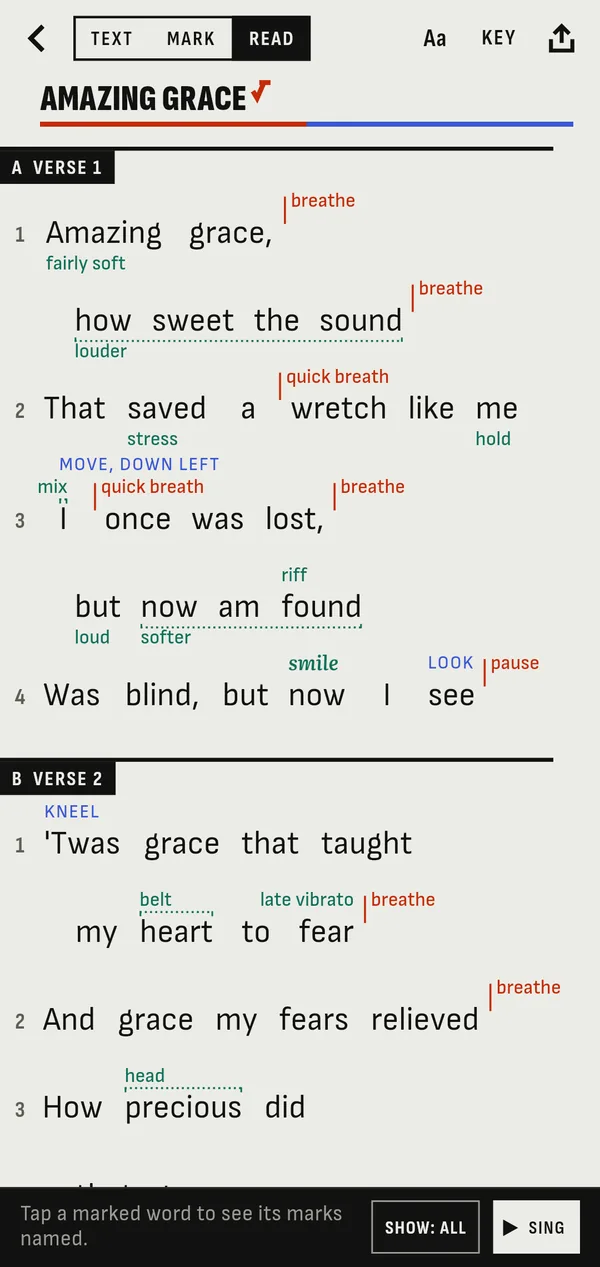
Read shows the marked lyric large, with the marks as plain words ("fairly soft", "louder", "stress") or as music signs. Tap a marked word to see what its marks are called. Share makes one clean PDF sheet; in signs, a Key at the foot explains only the marks used in that song.
Free. No account.
Questions people ask
What is the difference between mp and mf?
mp (mezzo piano) is moderately soft and mf (mezzo forte) is moderately loud. They are the two middle levels between p and f, and like all dynamics they are relative to the rest of the song.
Is decrescendo the same as diminuendo?
Yes, for practical purposes. Both mean get gradually softer, and both can be written as a closing wedge.
What does a fermata mean for a singer?
Hold the note longer than written. How long is your choice or the conductor's, so agree it with whoever is playing for you.
How do you write dynamics on lyrics without sheet music?
Put the letter under the word where the level starts. For a gradual change, draw a line or wedge under the words it covers, so you can see where it ends.
What does "throw away" mean in singing?
Sing a word lightly, almost spoken, so it passes quickly and the words around it stand out. It is the opposite of a stress.