 Songplanner
Where should you breathe in a song, and how do you mark it?
Updated 28 November 2026
Breathe where the words take a breath: at punctuation, at the end of a thought, and in the rests. Then cut that list down. Most singers breathe too often, not too little, and the plan you want is the fewest breaths that still get you to the end of every phrase with some air left.
Mark the plan on the lyric before you rehearse it. The usual sign is a small tick or comma above the gap between two words, the same breath mark singers and wind players see in printed music. Add a sign for a quick breath and one for "no breath here", and the whole plan reads at a glance, on a lyric sheet or on a score.
Step 1: read the words aloud
Before you sing a note, speak the lyric at roughly the song's pace. Where you pause naturally, the sense of the words breaks, and that is a place you could breathe. Rollo Fisher's voice class on Lumen Learning puts the rule simply: if there is a punctuation mark, breathe or pause there. It also warns that most lyric websites leave the punctuation out, so if your copy has none, reading it aloud is how you find it again.
A few places to avoid, whatever the punctuation says:
- Inside a word, or between two words that belong together: an adjective and its noun, a verb and its object.
- Just before the last word of a line, unless the music leaves you no choice. A breath there turns one line into two.
- Right before the most important word of the song. Breathe a little earlier, so you arrive at that word with air instead of reaching for it.
Step 2: check it against the music
Now sing it through with the track or the score, and look at three things.
Rests. A rest is a free breath. Pamelia S. Phillips, in Singing For Dummies, lists rests first among the places to breathe, then punctuation, then anywhere that makes sense with both the phrase and the words.
Where the time comes from. A breath mark does not stop the beat. As the Wikipedia article on breath marks puts it, the breath normally shortens the note before it, so the time to breathe is taken from the end of the last word, not added after it. If that last word is a long note you want to hold, the breath has to go somewhere else, or become a quick one.
How long the next phrase is. Before a long phrase, take a full breath even if a quick one would fit. Before a short phrase that starts right on the beat, a quick, shallow breath is often all there is time for.
Step 3: take breaths out
John Bertalot, a choir trainer who directed music at Blackburn Cathedral and at Trinity Church in Princeton, wrote that if one fault above all others is shared by many choirs, it is "breathing twice too often", usually in the middle of a line rather than at its end. Solo singers do it too, often out of nerves. Fisher's class makes the same point from the other side: a breath at the end of every line can be more breaths than the song needs.
So go through your marks and ask of each one: do I need this, or is it habit? If you get through the next phrase comfortably without it, rub it out. If a phrase is long and you want it in one breath, mark "no breath" across the gap where you would be tempted. Bertalot's tip for carrying a line over is a slight crescendo through the word where you would otherwise breathe, so the phrase keeps moving forward.
Don't push it to the edge, though. A phrase you can only finish on your very last bit of air may work in your room and fall short on the day.
The marks, and what each one tells you
- Full breath. A tick or comma above the gap. In printed music it sits just above the staff, usually at the end of a phrase.
- Quick breath. A smaller tick, or a tick in brackets: a sip of air where there is no time for more.
- Pause, or lift. A short silence with no real breath, to set a word apart. Printed music has a longer cousin, the caesura, two slashes that MuseScore's handbook describes as slightly longer than a breath mark but shorter than a fermata.
- No breath. An arc over the gap, or simply the words "no breath". It stops the habit breath you would otherwise take on autopilot.
- Link. A small curve under two words that should run together, with no gap at all.
Whatever signs you choose, use the same ones in every song, and keep them in pencil until the song settles.
An example: Shenandoah
Here is the first verse of "Shenandoah", a traditional American song, marked for a slow solo performance.
- A quick breath after each "Shenandoah", because "I long to see you" follows right away.
- A full breath at every line end except one.
- A lift after the first "Away,": a tiny gap for the sense, with no air taken.
- No breath between "bound away" and "'Cross the wide Missouri", so the last two lines arrive as one long sweep, with a hold on the final word. That is the phrase to save air for, so make the full breath before "Away, I'm bound away" a deep one.
Your version may differ. A slower tempo or another key can move every mark.
Step 4: test it, then fix it
Sing the whole song with the marks, at full voice and full tempo, three times in a row. Do it after you have warmed up (Scalita's quick vocal warm-up is five exercises on a piano set to your range), because singing out uses more air than humming the song through.
Phillips treats each mark as an experiment: try the breath, and if it feels wrong, pick another place and try again. Where you run short, move the breath earlier or add a quick one. Where you never use a mark, take it out. Then sing it again the next day. A breath plan settles over a few days, and it often ends with fewer marks than it started with.
Do this in Songplanner
Songplanner is a free Android app for marking up your own lyric. Paste the words, open Mark and pick Breath: full breath, quick breath, pause, no breath and link. Tap a gap between two words to place one. The Line ends button puts a full breath at the end of every line in one go, and you move the exceptions, which is Step 3 above: start with too many, then take some out.
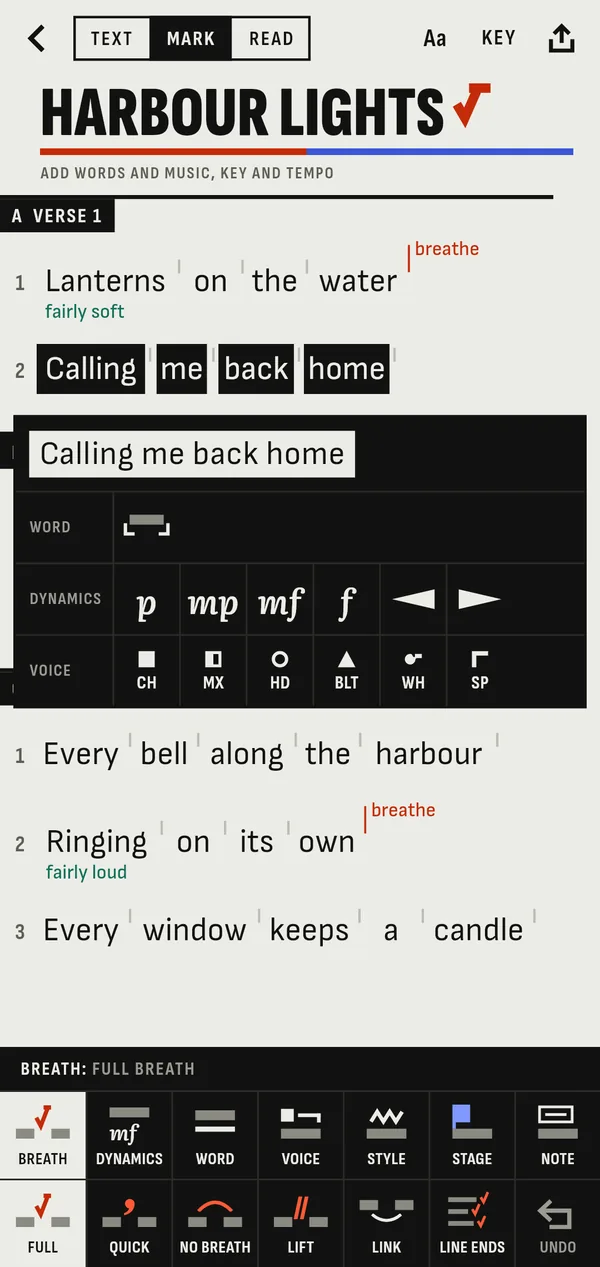
Breaths show in red, as plain words such as "breathe" and "quick breath", or as music signs if you prefer. Sing scrolls the marked lyric with your own backing track, so you can test the plan at tempo, and Share turns it into one clean PDF sheet for your next lesson. Change a breath afterwards, share again, and the sheet carries the next version number.
Free. No account.
Questions people ask
Should I breathe at every comma?
No. A comma is a place where you may breathe, not one where you must. Breathe at the commas you need for the next phrase and sing through the rest.
What does a comma above the notes mean?
It is a breath mark. It tells a singer or wind player to breathe there, and the time usually comes from the end of the note before it, so the beat keeps going.
How do I know if I'm breathing too often?
If you finish most phrases with plenty of air left, or your breaths split lines that make sense as one thought, you are probably breathing too often. Take out one mark at a time and check that the phrase still lands.
What if a phrase is too long for one breath?
Add a quick breath at the least damaging spot, usually after a comma or between two ideas, rather than gasping at the end. If the whole song feels like that, a lower key or a slightly quicker tempo may help more than any breath mark.
Do choirs mark breaths the same way?
Yes, with the same signs. On long held notes, choirs also use stagger breathing: singers on the same part breathe at different moments, so the sound never stops.
Sources
- Wikipedia: Breath mark
- MuseScore Handbook: Breaths and pauses
- John Bertalot, "Breathe", Choir training (2013)
- Rollo Fisher, "Basics of Singing 4: The Rules of Good Singing", Voice Class, Lumen Learning
- Pamelia S. Phillips, "Breath Control in Singing: How and When to Breathe", Singing For Dummies
- Wikipedia: Stagger breathing