 Songplanner
How do you prepare a song for an audition in one week?
Updated 28 November 2026
A week is enough to prepare one song well, as long as you already know the tune and you do the work in the right order: settle the cut and the key first, get the words off the page early, plan your breaths and dynamics, prepare the pianist's copy, then sing it for real people before the day. Each step depends on the one before it, so the order matters more than the hours.
The plan below gives each day one main job and assumes about an hour a day. If you have not chosen the song yet, choose it today, and use the list of things to avoid near the end of this guide.
Day 1: the notice, the cut and the key
Read the audition notice twice. Note how long they want you to sing, whether there is a pianist or you bring a track, and anything they ask for or rule out.
Most musical theatre auditions ask for a cut, not the whole song. Jose Simbulan, an accompanist writing for BroadwayWorld, describes an audition cut as a 16-bar or 32-bar excerpt of about 30 to 60 seconds. Pick the stretch that shows your best singing and at least one change of feeling, not just the first 16 bars.
Then fix the key. The University of Cincinnati's College-Conservatory of Music (CCM) asks for music in the correct key with all cuts clearly marked, and warns not to expect the pianist to transpose on sight. If the printed key is wrong for you, get a copy in your key now, not on day 6.
Day 2: the words on their own
Copy out the lyric of your cut with its punctuation. Then speak it as if it were a monologue: who are you talking to, what do you want from them, and where does the thought change? Mark those changes. If the song is in another language, Bruce Schoonmaker of Furman University puts it this way: know the proper pronunciation, and know both the word-for-word translation and the general mood and meaning.
Start learning the words today, by testing yourself rather than rereading: look at a line, cover the next, say it, check. The guide on how to memorize song lyrics explains why that works better.
Day 3: the breath and dynamics plan
Now mark how you will sing it. Put your breaths in first (see how to mark breaths in a song), then the dynamics: where the cut starts, where it builds to, and where it pulls back. Even 16 bars need a shape. If every line is the same level, the panel hears one idea, however good the voice.
Here is how that might look on the first verse of "Greensleeves", with the thought changes from day 2 written in as notes:
Keep the marks in pencil. You will change some of them on day 5.
Day 4: the pianist's copy
If a pianist plays for you, the sheet music has to be readable by a stranger at sight. Simbulan's checklist:
- mark clearly where you start and where you end;
- keep cuts simple, drawn with a pencil and a straight edge;
- put the tempo at the top, and mark any tempo changes boldly;
- circle the key signature and time signature in pencil wherever they appear or change;
- use a three-ring binder so the music cannot slide off the piano, and lay a two-page song side by side.
CCM adds that you set the tempo by singing a few phrases to the pianist, not by snapping your fingers. Practise that today: sing the first line quietly at your tempo, the way you will in the room.
Then rehearse with the accompaniment in your key, either a pianist or a recording, so the introduction and your first note are no surprise.
Day 5: off the page, on your feet
Sing the cut from memory, standing, in the shoes you will wear. Run it from the introduction to the last note, then reset and do it again. Record one run on your phone and watch it once, looking for one thing only: where your eyes go, what your hands do, or whether the dynamics you marked actually happen.
Fix what the recording shows, then update your marks. If a breath keeps catching you short, move it now, not in the waiting room.
Day 6: sing it for people
Boise State University's advice to singers auditioning for its music program is to memorize the music so well that you could sing it in your sleep, then practise performing it in front of friends, family and teachers. Schoonmaker goes further: practise your auditions with people who intimidate you as your audience.
Run the whole visit, not just the song. Walk in, say your name and the song, show the pianist the start, end and tempo, sing, say thank you, leave. CCM asks auditionees to say their name "with authority" and to leave "with the air of a job well done". It feels silly in a living room. It is much less silly than doing it for the first time in front of a panel.
Day 7: rest, then check the bag
Sing lightly: a warm-up, one easy run of the cut, and stop. Pack the binder, check the key and the marked cut one more time, and add a spare copy. Schoonmaker's last item is simple and easy to forget: before you leave, double check that you have all your music.
On the day itself, warm up before you go in. Scalita's quick vocal warm-up is five exercises on a piano set to your range.
What to leave out
CCM's audition guidance lists what tends to hurt more than help:
- songs performed constantly, songs tied to one famous artist, and the current hit from the newest show;
- songs written for a character much older than you, and very emotional pieces;
- patter songs and other material that is hard to perform under stress;
- choreographed routines, and imitating your favourite performer.
Do this in Songplanner
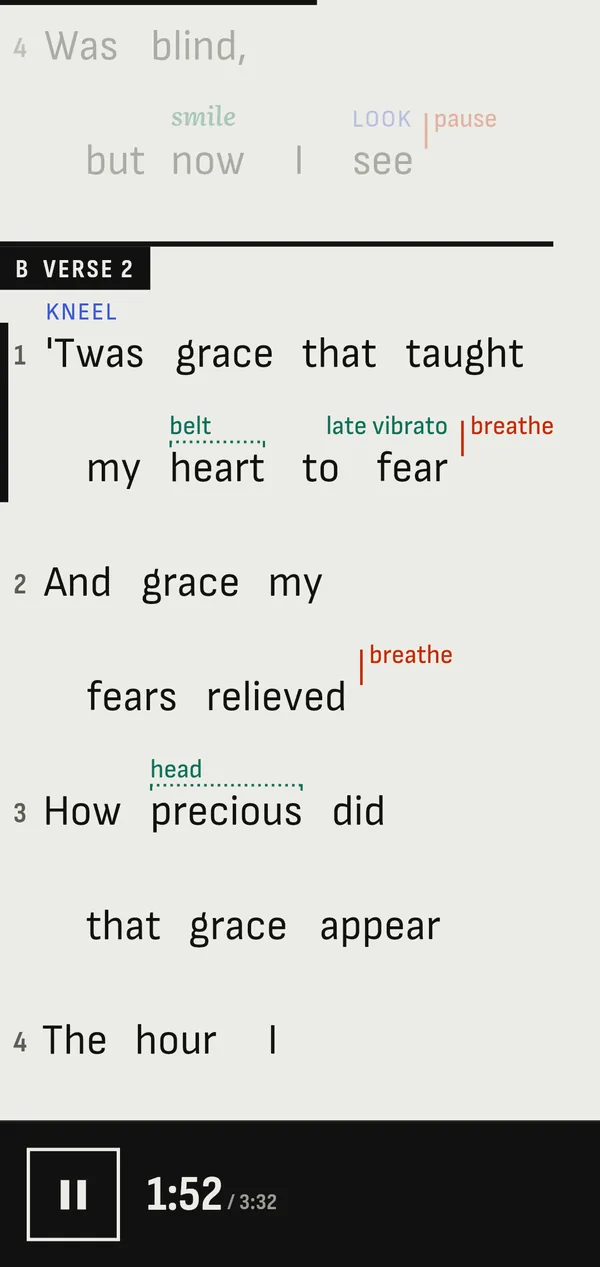
Songplanner, a free Android app, holds days 2, 3 and 5 of this plan in one place. Paste the lyric of your cut and mark the breaths, dynamics and notes on the words. Read shows the plan in large type for practice away from the piano. Sing scrolls it over your own recording of the accompaniment, so you can run the cut at tempo; give the introduction a start time and the words wait for it.
Share turns the plan into one clean PDF sheet to send to your teacher or coach, with a version number and date, so after a lesson everyone knows which copy is the latest.
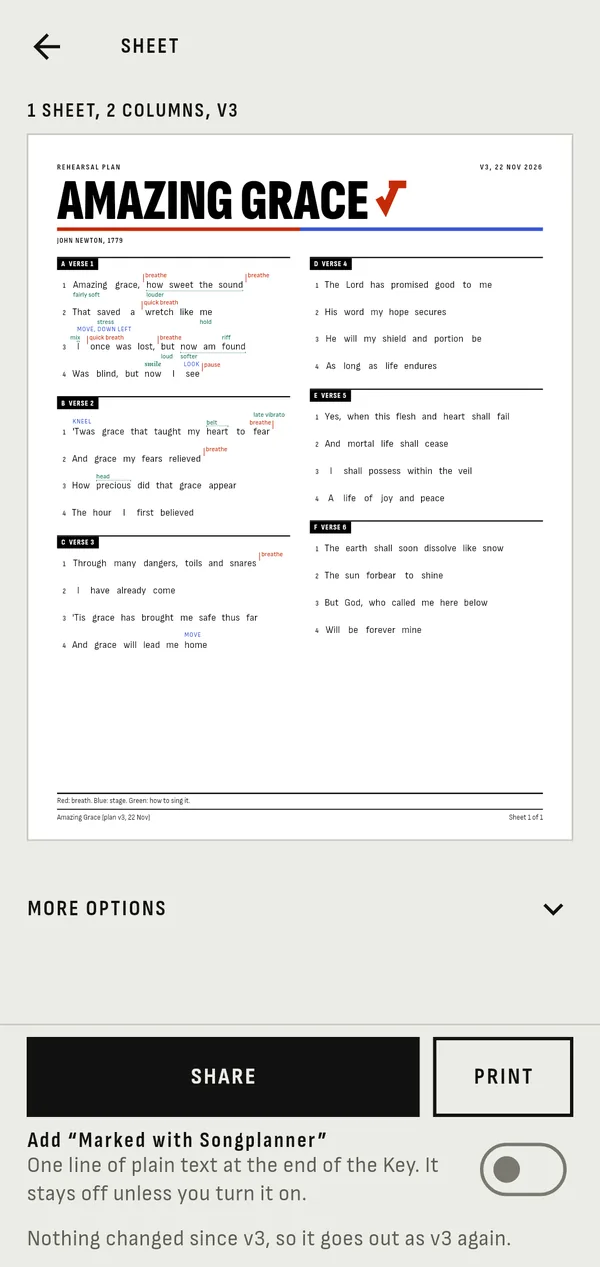
Two honest limits. The pianist still needs the printed music with the notes; Songplanner's sheet is the lyric and your plan, not a score. And in the room, sing from memory and leave the phone in your bag.
Free. No account.
Questions people ask
How long is a 16-bar audition cut?
Usually about 30 seconds, and a 32-bar cut about a minute, depending on the tempo. If the notice gives a time limit instead of bars, time your cut with the introduction included.
Should I sing from memory at an audition?
Yes. Programs such as Boise State's ask for memorized selections, and a singer reading the words cannot look at the scene they are playing.
Can I bring a backing track instead of using the pianist?
It depends on the audition. CCM's auditions, for example, rule out taped accompaniment and unaccompanied singing, while some calls ask for a track or a recorded video. The notice decides.
What if I forget the words in the audition?
Keep going. Experienced performers, as Roger Chaffin and colleagues describe in the Oxford Handbook of Music Psychology, don't go back to the beginning; they jump ahead to the next point they know. Sing on to the next line you are sure of and finish the cut.
How do I give the pianist my tempo?
Sing the first phrase or two quietly at your tempo while pointing at the start of the music. Don't clap, snap or conduct.
Sources
- College-Conservatory of Music, University of Cincinnati: Audition best practices
- Jose Simbulan, on preparing your audition book and working with accompanists, BroadwayWorld (December 2019)
- Boise State University, Department of Music: Vocal auditions
- Bruce Schoonmaker, "Advice on Auditioning for Colleges and Grad Schools", Furman University
- Roger Chaffin, Topher R. Logan and Kristen T. Begosh, "Performing from memory", The Oxford Handbook of Music Psychology (2009)