 Songplanner
How do you memorize song lyrics, and stop needing the teleprompter?
Updated 28 November 2026
Memorize lyrics by recalling them, not by rereading them. Look at one line, cover what follows, say the next line from memory, then check. Work through the song in order like that, in short sessions spread over several days, and practise starting from the first line of each section as well as from the top, so you can pick the song up anywhere.
Then let the teleprompter go in stages: sing with it, then with it out of sight, peeking only when you are stuck, then without it. Every peek tells you exactly which line needs more work.
Why singing along is not enough
Singing along with the track feels like learning, because the words come out. But the track is doing half the remembering for you, and the first time you sing without it, the gaps show.
Memory research has a name for the better method: retrieval practice, or the testing effect. In a well-known 2006 study, Henry Roediger and Jeffrey Karpicke had students either reread a passage or try to recall it from memory. Five minutes later the rereaders did slightly better. A week later the picture had turned around: the students who had tested themselves recalled 56% of the passage, against 42% for those who had reread it. The rereaders also felt more confident than they should have. Singing along is rereading with a tune.
Learn it as a chain, in order
A lyric is a chain: each line cues the next. Roger Chaffin and colleagues, in the Oxford Handbook of Music Psychology, describe exactly this kind of memory as an associative chain, where each passage cues what comes next. So build the chain on purpose:
- Read the whole lyric aloud once, for sense. Who is speaking, to whom, and what changes from verse to verse?
- Go line by line. Look at line 1, cover the rest, say line 2. Check. If it was right, go on. If not, read it, cover it again, and say it again.
- Work in sections. Add the next section only when the one you are on comes out without help.
- Practise the joins. The step from the last line of a verse into the chorus, and from the chorus back into the next verse, is a common place to lose the thread.
- Learn the order of the verses as its own fact. A repeated chorus only needs learning once, but which verse comes after it does not repeat.
Speaking or writing the lyric out from memory both count as recall. In a six-year case study, the singer and researcher Jane Ginsborg wrote out a piece from memory as a normal part of her practice, to check that her memory was secure.
Then learn the way in
Chains have a weakness. As Chaffin's chapter puts it, to reach any link you have to start at the beginning.
Experienced performers build a second kind of memory on top: a map of the song with landmarks they can jump to. When something goes wrong, they don't stop and start again; they go on from the next landmark. In Ginsborg and Chaffin's study, the starts of sections and phrases worked as those landmarks: recall was best right at each boundary and dropped off bar by bar after it.
So once the chain holds, practise from the middle: the second chorus, the bridge, the last verse. If you can begin anywhere, a slip costs you one line, not the song.
Spread it over days
One long session the night before does less than the same time spread over several days. A 2006 review by Nicholas Cepeda and colleagues pooled 317 experiments on spacing and found that spreading practice out improves recall, and that the best gap between sessions grows with how long you need to remember. For a gig next week, a short session every day works well. For a song you need to keep for months, widen the gaps once it is solid, and come back to it.
Even then, memory fades without use. In Ginsborg and Chaffin's study, the singer's written recall of the piece fell from 97% five days before the performance to 66% four years later. Plan a quick run-through of older songs before you need them again.
Words and tune together
Once you know the words roughly, sing them rather than only speaking them. Chaffin's chapter notes that in songs, the constraints of the words and the music combine, which makes memorizing easier when the two are learned together. In the same case study, the singer's sung recall nearly six years on was 89% accurate, far better than her written recall.
Sing it a cappella before you sing it with the track. Without the track you find out whether you know the song or the recording does.
Mark the landmarks
Ginsborg and Chaffin also found that places the singer had thought hard about in rehearsal, such as the meaning or stress of a word, became landmarks of their own. You can make that work for you: mark one stressed word per line and give it a reason. The marks become hooks.
The first verse of "Auld Lang Syne" (Robert Burns, 1788): one stressed word per line, and a hold where the repeated line turns into the question.
Letting the teleprompter go
A teleprompter is a fine safety net and a poor teacher. Wean yourself off it in steps:
- Learn first. Do the line-by-line work before you lean on the screen.
- Run with it, eyes up. Look at it only when you need to.
- Run with it out of sight. Turn it away or put it on a chair. Peek only when you are stuck, and write down where.
- Drill the peeks. Those lines are your homework for the next session.
- Two clean runs, then decide. When you get through twice in a row without looking, keep the prompter as a safety net or leave it at home.
Chaffin's chapter warns that students often assume that because they can get through a piece without the score in the practice room, they can do the same in live performance. Do the last step in front of someone.
A sibling app for the drilling: ReciteFlow
The maker of Songplanner also makes ReciteFlow, an Android app built for exactly the line-by-line work in this guide. It shows you one line and asks for the next; you say or sing it from memory, reveal it and rate how it went, and spaced repetition decides when each line comes back. You can give it the date you need the song by, and it paces the practice to that day. A repeated chorus is learned once, and the first line of each section gets its own card that shows how the previous section ends, so you practise the joins. It is words only, with no audio, so you find out whether you really know the lyric without the track carrying you. It is free to start.
The two apps split the job. ReciteFlow gets the words into your head in order; Songplanner holds how you plan to sing them.
Do this in Songplanner
Songplanner, a free Android app, is where your marked lyric lives once you know the words: breaths, dynamics, voice and the stressed words you use as landmarks. Read shows it in large type for a quiet run-through, and Sing scrolls it over your own backing track for the stage.
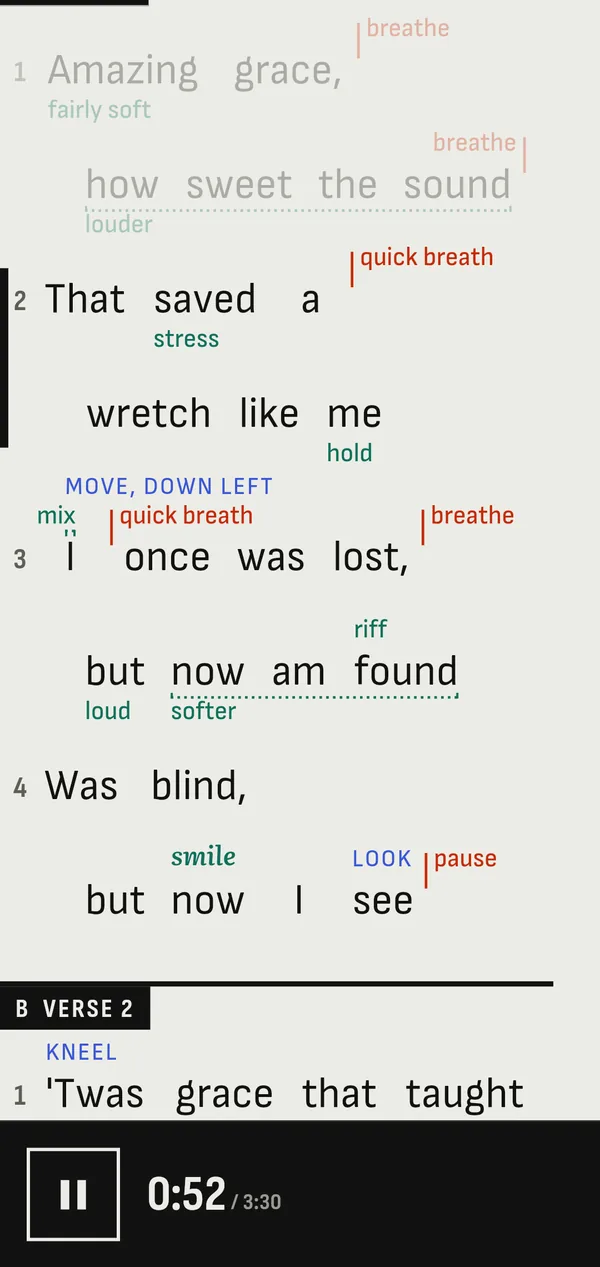
Songplanner does not test you or hide lines; for that, use the method above or ReciteFlow. Sing is for the run-throughs, and for the safety net afterwards if you want one.
Free. No account.
Questions people ask
How long does it take to memorize a song?
It depends on the length, the language and how well you already know the tune. Plan on several short sessions over a few days rather than one long one, and start earlier than feels necessary.
Is it better to memorize lyrics by writing them out?
Writing them out from memory works, because it is recall. Copying them while looking is closer to rereading. Check your version against the original afterwards.
Why do I forget lyrics on stage when I know them at home?
At home the room, the track and the calm all help you remember. On stage they change. Practise starting from different sections and run the song for other people before the show.
Should I learn the words before the melody?
Read the words for meaning first, then learn them with the melody. Words and tune support each other when they are learned together.
What should I do if I blank in the middle of a song?
Keep the music going and jump to the next line or section you are sure of. Most audiences never notice a skipped line, but everyone notices a stop.
Sources
- Henry L. Roediger III and Jeffrey D. Karpicke, "Test-Enhanced Learning: Taking Memory Tests Improves Long-Term Retention", Psychological Science 17(3) (2006)
- Nicholas J. Cepeda and others, "Distributed Practice in Verbal Recall Tasks: A Review and Quantitative Synthesis", Psychological Bulletin 132(3) (2006)
- Roger Chaffin, Topher R. Logan and Kristen T. Begosh, "Performing from memory", The Oxford Handbook of Music Psychology (2009)
- Jane Ginsborg and Roger Chaffin, "Very long term memory for words and melody: an expert singer's written and sung recall over six years", International Conference on Music Communication Science (2009)